
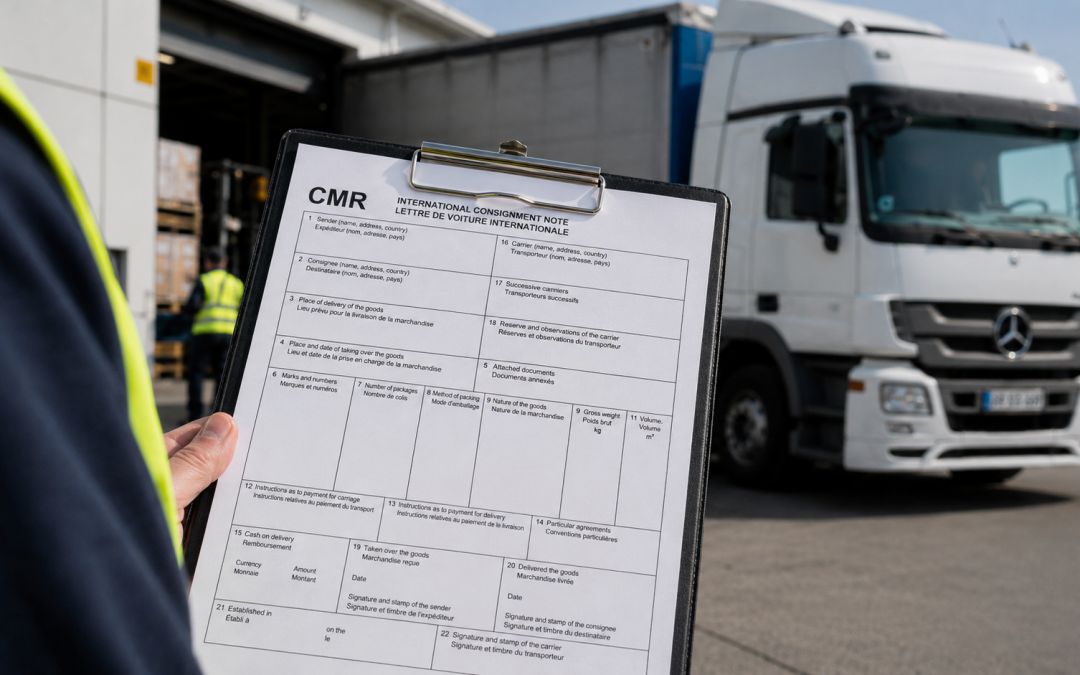
The CMR in international transport is one of the key documents when a company needs to send goods by road outside Spain. Although it may seem like a simple formality, the CMR consignment note helps identify the operation, the parties involved, the goods being transported and the basic conditions of the shipment.
In international transport, good document management is just as important as preparing the load correctly, choosing the right vehicle and coordinating collection and delivery times. At Subitur, we offer road freight transport solutions tailored to each customer, with experience in both national and international routes.
What is the CMR in international transport?
The CMR is the consignment note used in the international carriage of goods by road. Its name comes from the Convention on the Contract for the International Carriage of Goods by Road, commonly known as the CMR Convention.
This document is used when the place of collection and the place of delivery are located in two different countries, provided that at least one of them is a party to the convention. In practice, the CMR accompanies the goods during the journey and records the conditions agreed between the sender, carrier and consignee.
What is the CMR consignment note used for?
The CMR consignment note helps organise the logistics operation and reduce possible incidents during transport. Among other functions, it identifies the sender, carrier and consignee, indicates the loading and delivery points, describes the goods, details the number of packages and their weight, and includes any specific instructions.
The CMR Convention also establishes that the consignment note is issued in three original copies: one for the sender, one that accompanies the goods and one for the carrier.
What information should a CMR include?
For the CMR to be useful, it must be completed correctly. It usually includes the place and date of issue, the details of the sender, carrier and consignee, the place of collection, the delivery point, the description of the goods, the type of packaging, the number of packages, the gross weight and any instructions required for the operation.
An error in this information can lead to delays, confusion at destination or problems in the event of an incident. For this reason, before sending goods internationally, it is advisable to review all documentation in advance.
Documentation and preparation of the goods
A correctly completed CMR does not replace proper preparation of the load. The information on the document must match the actual goods: number of packages, weight, volume, references, packaging and destination.
Before collection, it is important to check labelling, palletising, the condition of the packaging, loading and unloading times, and access conditions at both origin and destination. This coordination helps avoid delays and makes transport safer and more efficient.
It is also important to remember that the CMR does not replace other commercial or administrative documents. Depending on the type of goods, destination or route, delivery notes, invoices, certificates, authorisations or customs documentation may also be required.
The role of the carrier in the CMR
In an international operation, the carrier does more than simply move the goods. The carrier also plays a role in the correct execution of the transport, reviews essential information, accompanies the shipment with the relevant documentation and delivers the goods at destination.
At Subitur, we have a fleet prepared for different logistics needs, vehicles equipped with GPS geolocation systems and a team with experience in national and international routes. This traceability provides greater control over the goods throughout the journey.
In addition, our transport and logistics certifications reinforce our commitment to quality, safety and compliance with the requirements of each operation.
Electronic CMR: towards more digital logistics
Digitalisation is also transforming transport documentation. The e-CMR, or electronic consignment note, makes it possible to manage this document digitally, reduce paper use and speed up the exchange of information between the parties involved.
The United Nations Economic Commission for Europe provides information on the development and use of the e-CMR, an evolution that fits with increasingly traceable, efficient and connected logistics.
Subitur, international transport with planning and control
The CMR in international transport is much more than an administrative document. It is a key tool for organising the shipment, identifying the goods, recording the conditions of transport and reducing incidents during the route.
At Subitur, we work to offer logistics solutions tailored to each customer, with services including full loads, groupage, storage, bulk goods, waste and specialised transport. If your company needs to send goods by road internationally, you can contact Subitur and request more information about our road transport services.